Research fellow LSU- Radiology department LSU- Radiology department shreveport, Louisiana, United States
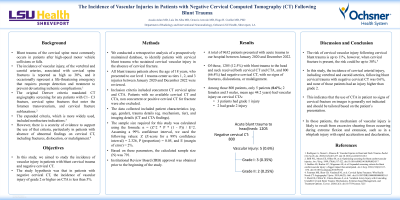
Purpose: Background Computed tomography angiography (CTA) is used to rapidly screen for cervical vascular injury as a result of blunt cervical trauma. The original Denver criteria mandated CTA screening for any patients with C1– C3 fracture, cervical spine fractures that enter the foramen transversarium, and cervical fracture subluxations. The expanded criteria, which is more widely used, included non-fracture indications. However, there is a scarcity of evidence to support the use of that criteria, particularly in patients with negative CT.
Objectives To evaluate the incidence of cervical vascular injury, detected on CTA, in patients with negative cervical CT.
Methods/Materials: Methods We conducted a retrospective analysis on trauma patients between January 2020 and December 2022 who received both cervical CT and CTA. The sample size was calculated using the following formula: n = (Z^2 * P * (1 - P)) / E^2, with a confidence interval of 99%, margin of error of 2%, and proportion of 0.05.
Results: Results A total of 800 patients with blunt trauma and negative cervical CT scan were randomly selected. Among those, 20 patients (2.5%) had vascular injury on CT angiogram (male:female ratio of 1:1.5, mean age 38.6 years). Based on the grade of injury, 9 patients (1.125%) were grade 1, 4 patients (0.5%) were grade 2, 5 patients (0.625%) were grade 4, and 2 patients (0.25%) were grade 5.
Conclusions: Conclusion This study addressed the utility of CTA in patients with negative cervical CT. Only a small percentage of patients had a CTA positive of vascular injury, and only 1.4% had a grade 2 or higher injury.