Assistant Professor Baylor College of Medicine, United States
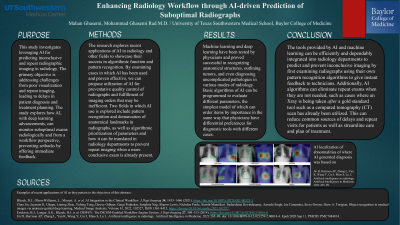
Purpose: This study investigates leveraging AI for predicting inconclusive and repeat radiographic imaging in radiology. The primary objective is addressing challenges from poor visualization and repeat imaging, leading to delays in patient diagnosis and treatment planning. The study explores how AI, with deep learning advancements, can monitor suboptimal exams radiologically and from a workflow perspective, preventing setbacks by offering immediate feedback.
Methods/Materials: The research explores recent applications of AI in radiology and other fields to showcase their success in algorithmic function and pattern recognition. By examining cases in which AI has been used and proven effective, we can purpose utilization of AI for preventative quality control of radiographs and fulfillment of imaging orders that may be inefficient. Two fields in which AI use are explored include pattern recognition and demarcation of anatomical landmarks in radiographs, as well as algorithmic prioritization of parameters and how it can be translated in radiology departments to prevent repeat imaging when a more conclusive exam is already present.
Results: Machine learning and deep learning have been tested by physicians and proved successful in recognizing anatomical structures, outlining tumors, and even diagnosing low suspicion pathologies in various modes of radiology. Basic algorithms of AI can be programmed to evaluate different parameters, the simplest model of which can order items by importance in the same way that physicians have differential preferences for diagnostic tools with different cases.
Conclusions: The tools provided by AI and machine learning can be efficiently and dependably integrated into radiology departments to predict and prevent inconclusive imaging by first examining radiographs using their own pattern recognition algorithms to give instant feedback to technicians. Additionally, AI algorithms can eliminate repeat exams when they are not needed, such as cases where an Xray is being taken when a gold standard tool such as a computed tomography (CT) scan has already been utilized. This can reduce common sources of delays and repeat visits for patients as well as streamline care and plan of treatment.