Assistant Professor Yale University, United States
Purpose: Incidental findings are common, often requiring radiologists to communicate recommendations for follow-up imaging. No universal incidental reporting standards currently exist [1]. Many recommendations involve a complex, difficult to remember algorithm. Solutions for improved follow up have been proposed [2, 3], few of which focus on methods for dictating findings and recommendations within the radiology report. Dictation software may include built tools, which are often cumbersome and require many clicks to navigate. We seek to demonstrate a standardized, macro-based approach to quickly reporting follow up guidelines for incidental findings.
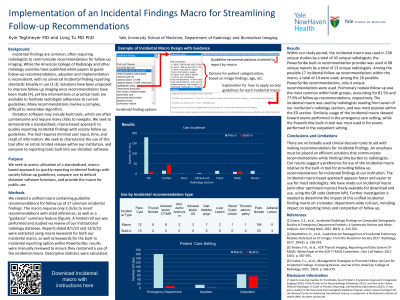
Methods/Materials: We created a unified macro containing guideline recommendations for follow up of 17 common incidental findings. The macro requires only 2 clicks to insert recommendations with cited references, as well as a “guidance” summary feature (figure). A limited roll out was performed and studied via review of our institutional radiology database. Reports dated 8/1/23 and 12/5/23 were pulled using macro keywords; results were manually reviewed to ensure they contained a use of the incidental macro. Descriptive statistics were calculated.
Results: Within this limited pre-launch, the incidental macro was used in 29 reports dictated by 10 unique residents and 16 attendings. 20/29 uses occurred within the emergency radiology section, with fewer uses in the body, cardiac and chest sections. The macro was most used for CT exams (20/29), followed by ultrasound (6/29) and MRI (3/29). 7 of the 17 included incidentals were used, most frequently for pancreatic cysts (11/29), followed by adnexal lesions and gallbladder polyps (6/29).
Conclusions: There is currently no consensus on how follow up recommendations should be reported. An emphasis must be placed on efficient solutions that communicate recommendations while limiting time burden to radiologists; we hope that our macro-based solution offers radiologists a rapid and standardized way to dictate such recommendations. Further investigation is needed to determine the impact of this unified incidental finding macro on a broader, department-wide roll-out, including impact on reporting times and completion of follow up.