Medical Student Drexel University College of Medicine Drexel University College of Medicine Reading, Pennsylvania, United States
Purpose: In 1978, a task force warned against uncritical reliance on computer-interpreted electrocardiograms (C-I EKGs), suggesting qualified physician review. Today, similar caution arises as artificial intelligence (AI) read X-rays gain popularity. This review explores how AI-read X-rays enhance diagnostics and their integration into the medical field.
Methods/Materials: Multiple databases were searched using the keywords "artificial intelligence" and "X-ray." Inclusion criteria focused on studies from 2019-2023, specifically examining AI-read X-rays.
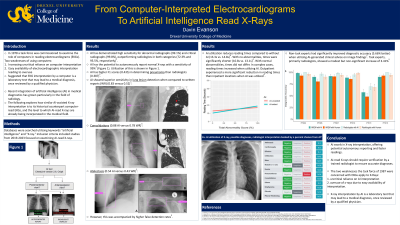
Results: AI has demonstrated high sensitivity for abnormal radiographs (99.1%) and critical radiographs (99.8%), outperforming radiologists in both categories (72.3% and 93.5%, respectively). AI has the potential to autonomously report normal X-rays with a sensitivity of 99%. AI has higher F1 scores (0.435) in determining pneumonia than radiologists (0.387). Ai showed superior sensitivity in lung lesion detection (0.83 versus 0.52), consolidations (0.88 versus 0.78), and atelectasis (0.54 versus 0.43) compared to written reports. However, this was accompanied by higher false detection rates.
AI can reduce total reading times compared to situations without AI (13.3s vs. 14.8s). With no abnormalities, reading times were significantly shorter (mean 10.8s vs. 13.1s). With normal abnormalities, reading times did not differ. In complex cases, reading times increased, particularly when utilizing AI. Notably, outpatient clinics experienced a more significant reduction in reading times than inpatient locations when AI was utilized.
The influence of AI-generated clinical advice on physicians' decision-making was evident in non-task experts. Non-task experts demonstrated a significant enhancement in diagnostic accuracy, with a 5.66% improvement, when utilizing AI-generated clinical advice on image findings. Task experts, primarily radiologists, showed a more modest but non-significant increase of 3.41%.
Conclusions: AI excels in X-ray interpretation, offering potential autonomous reporting and faster readings. However, akin to C-I EKGs, AI-read X-rays require verification by a qualified physician to ensure accurate diagnoses.