Medical Student Stanford University Stanford University Everett, Massachusetts, United States
Purpose: Neuroimaging is a critical way for physicians to diagnose a wide range of clinical pathologies. Results of the imaging are often utilized to guide the medical management plan. In this study, we investigated differences in the utilization of various imaging modalities in diverse patient populations, and explored the corresponding inpatient tumor diagnoses.
Methods/Materials: IBM marketscan was utilized to develop three cohorts depending on presence of the following neuroimaging history while being admitted as an inpatient: CT, MRI, and PET. Demographic variables investigated included region and gender. Only patients with images acquired or medical management for brain tumors in 2021 were included in this study. Outcomes of interest in this study were neuroimage quantity, hospital stay duration, and inpatient tumor diagnoses.
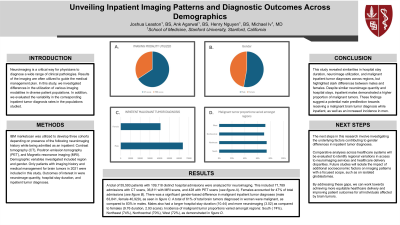
Results: A total of 55,593 patients with 109,118 distinct hospital admissions were analyzed for neuroimaging. This included 71,789 admissions with CT scans, 36,811 with MRI scans, and 428 with PET scans. Females accounted for 47% of total admissions. Malignant tumor proportions varied amongst regions: South (74%), Northeast (74%), Northcentral (70%), West (72%). There was a significant gender-based difference in malignant inpatient tumor diagnoses (male 63,841, female 40,929). A total of 61% total brain tumors diagnoses in women were malignant, as compared to 83% in males. Males also had a longer hospital stay duration (10.44) and more neuroimaging (3.02) as compared to females (9.76 duration, 2.93 scans).
Conclusions: This study unveiled similarities in hospital stay duration, neuroimage utilization, and malignant inpatient tumor diagnoses across regions, but highlighted stark differences between males and females. Despite similar neuroimage quantity and hospital stays, inpatient males demonstrated a higher proportion of malignant tumors. These findings suggest a potential male predilection towards receiving malignant brain tumors diagnosis while inpatient.