Pediatric Radiology Fellow Vanderbilt University, United States
Purpose: With an aging United States population and expanded access to radiology services for many patients, volumes in private and hospital settings have soared. Consequently, many private practices have moved to some variation of a quota system to set fair expectations and ensure equitable participation within a group. Our goal for this project was to determine if a similar model could have an observable impact on resident productivity in a medium-sized residency program at a large community hospital.
Methods/Materials: In July of 2022, with input from residency staff and administration, we implemented a quota system for R2, R3, and R4 residents on their respective neuroradiology rotations. R2s were asked to read at least 10 cross-sectional studies per day (50/week), and R3s/R4s were asked to read at least 20 cross-sectional studies per day (100/week). In 2023, two years of data were directly sourced from PACS software to determine the number of cases interpreted by each resident one year prior to and one year following the quota’s implementation. Weeks of evening/overnight call and all moonlighting shifts were excluded from the study. The data was then aggregated on a class-by-class basis, ensuring that individual resident production was not disclosed.
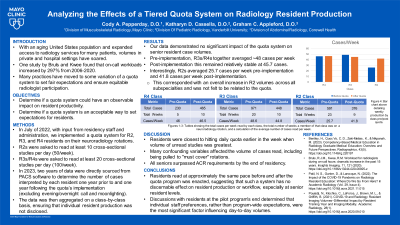
Results: The data in our study demonstrated no significant impact of the quota system on senior resident case volumes. Pre-implementation, R3s/R4s averaged 48 cases per week, and post-implementation this remained relatively stable at 45.7 cases. Interestingly, R2s averaged 25.7 cases per week pre-implementation and 41.8 cases per week post-implementation. This, however, corresponded with an overall increase in junior resident volumes across all subspecialties and was not felt to be related to the quota.
Conclusions: Residents were motivated to read at approximately the same pace before and after the quota program was enacted, suggesting that such a system has no discernable effect on resident production or workflow, especially at senior resident levels. Discussions with residents at the conclusion of the program determined that individual staff preferences, rather than program-wide expectations, were the most significant factors influencing day-to-day volumes.